

FACULTY OF COMPUTER SCIENCES
Bachelor of Science in Software Engineering
Department
Software Engineering
Level
Undergraduate
Semesters
08
Credit
136
INTRODUCTION
The Department of Software Engineering and Applied Sciences offers a 4-year BS Software Engineering program, which is duly approved by the National Computing Education and Accreditation Council (NCEAC). The department follows the latest HEC and NCEAC approved curriculum for BSSE. The curriculum not only focuses on the best processes, practices, and methodologies to apply in the production of high-quality and reliable software but also equips the students with the knowledge and skills required to practice as quality Computer Science professionals. Along with the theoretical knowledge of processes and methodologies, the curriculum is coupled with practical work that enables the students to get practical experience to analyze and solve real-world scenarios. As a part of training, the curriculum also facilitates the students for internships to get the actual zest of analyzing and designing real-world problems. The BSSE graduates find positions in the software industry as full-stack programmers, system analyst, product designer, project managers, and quality assurance.
- Program Duration
- Entry Requirements
Program Duration: 4 Years
Timing: Morning (Monday-Friday)
Location: 6.7 Km Japan Road, Sihala, Islamabad.
Recognized By: Higher Education Commission, NCEAC
Entry Requirement:
- 12 Years of Education, Intermediate (HSSC) examination, FSc (Pre-Engineering)/ ICS/ I. Com, A-Level, DAE (computer) with Mathematics and minimum 50% marks or equivalent qualification with Mathematics certified by IBCC.
- The students who have not studied Mathematics at intermediate level have to pass deficiency courses of Mathematics (06 credits) in first two semesters.
- Candidates having FSc (Pre-Medical) with minimum 50% marks are also eligible for admission but according to National Computing Education Accreditation Council (NCEAC) of HEC such students must pass deficiency courses of Mathematics of 6 credit hours within one year.
- Students who have successfully completed Associate Degrees in BSE are eligible for admission to the fifth semester of the BSE degree program without the need for any deficiency courses. However, these students must complete any required deficiency courses through a bridging semester, as determined by the admitting university, prior to entering the fifth semester. The minimum eligibility for admission to the fifth semester in the aforementioned cases is a CGPA of 2.00/4.00 in the prior qualification, i.e., the Associate Degree.
Entry Test: IBADAT International University Entry test / NAT
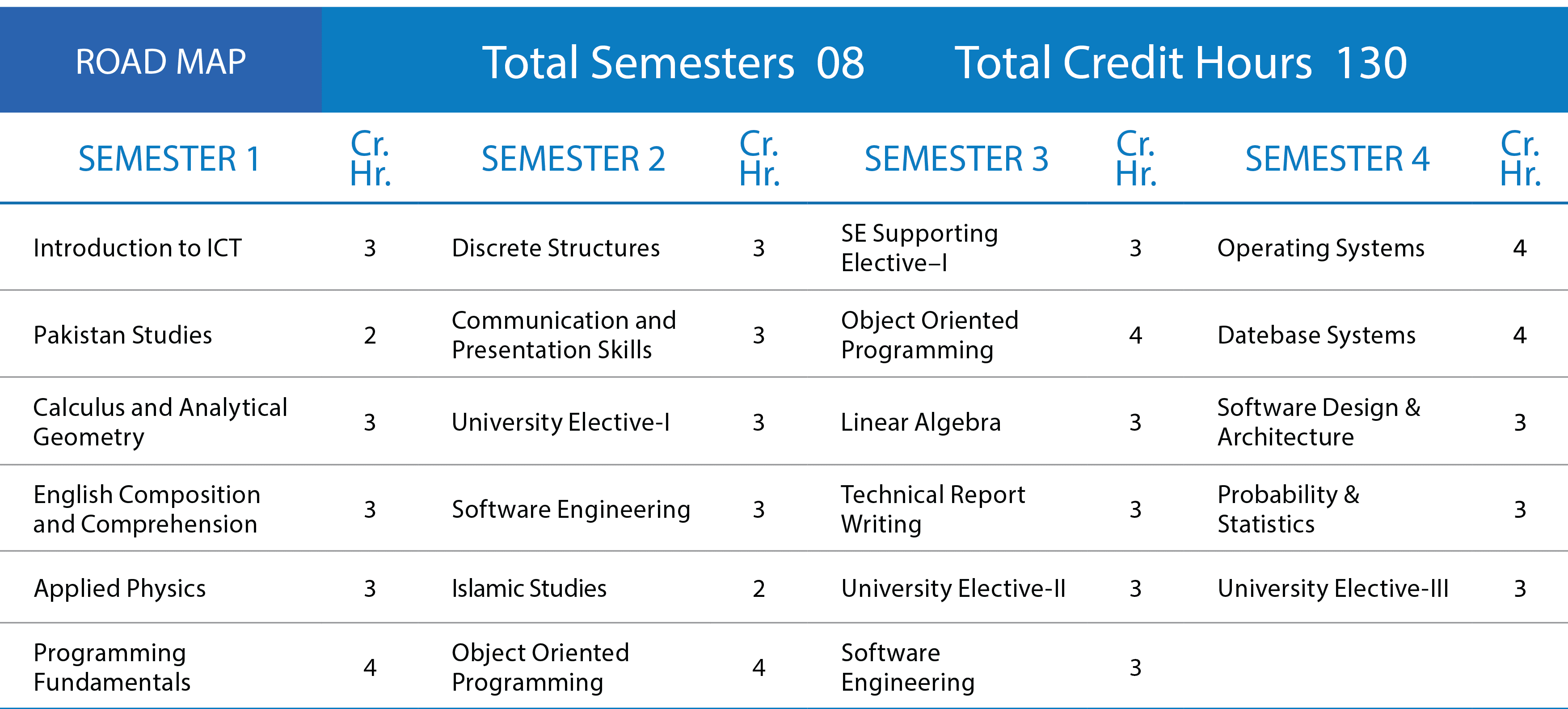
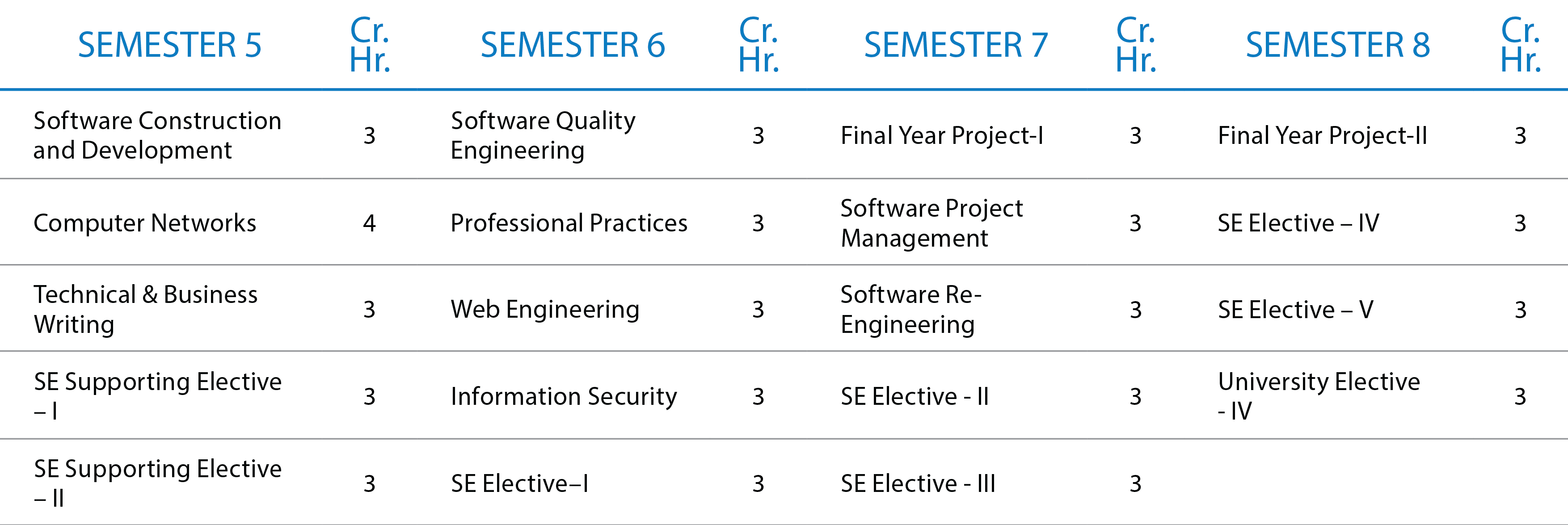
CAREER PROSPECTUS
This program is designed to prepare our students for a career as Software Engineers; System Analysts, Requirements Engineers, Software Architects, Quality Analysts, and Project managers. Software Engineers will help to develop software for telecommunications, financial systems, aeronautics, medical devices, transportation systems, banking and various government organizations.
MISSION STATEMENT
The mission of the Bachelor of Software Engineering program is “to deliver quality education that equips students with critical thinking, research capabilities, and transferable skills, fostering socially and ethically responsible Software Engineering graduates who are dedicated to professional development and continuous growth.”
PROGRAM EDUCATIONAL OBJECTIVES (PEOS)
Graduates from the Software Engineering program are expected to attain or achieve the following Program Educational Objectives:
PEO-1 Learn and apply a systematic, disciplined and quantifiable approach to the design, development, operation, and maintenance of software systems.
PEO-2 Design and implement large, reliable, efficient and economical software by applying the principles and practices of software engineering and communicate to the stakeholders.
PEO-3 Be well versed in all aspects of software life cycle from specification through analysis and design to testing, maintenance and evolution of software product as individual, team member, or as a lead
PROGRAM LEARNING OUTCOMES (PLOS)
PLO – 1 Academic Education: Following an accredited program of study designed to prepare graduates as software engineering professionals.
PLO – 2 Knowledge for Solving Software Engineering Problems: Apply knowledge of software engineering fundamentals and specialization, mathematics, computer science, and domain knowledge appropriate for abstraction and conceptualization of software engineering solution models.
PLO – 3 Problem Analysis: Identify, survey literature, and formulate complex software engineering problems to reach at substantiated conclusions using fundamental principles of mathematics, software engineering and computer science, and relevant domain disciplines.
PLO – 4 Design/ Development of Solutions: Design and evaluate solutions for complex software engineering problems, and develop and evaluate software systems, components, or processes that meet specified user needs with appropriate consideration for public health and safety, cultural, societal, and environmental considerations.
PLO – 5 Modern Tool Usage: Create, select, adapt and apply appropriate techniques, resources, and modern software engineering tools to complex software engineering activities, with an understanding of the scope of tools and technologies.
PLO – 6 Individual and Team Work: Function effectively as an individual and as a member or leader in diverse teams and in multi-disciplinary settings.
PLO – 7 Communication: Communicate effectively with the software engineering community and with society at large about complex software engineering activities by being able to comprehend and write effective reports, design documentation, make effective presentations, and give and understand clear instructions.
PLO – 8 Software Engineering Professionalism and Society: Understand and assess societal, health, safety, legal, and cultural issues within local and global contexts, and the consequential responsibilities relevant to professional software engineering practice.
PLO – 9 Ethics: Understand and commit to professional ethics, responsibilities, and norms of software engineering profession.
PLO – 10 Life-long Learning: Recognize the need, and have the ability, to engage in independent learning for continual development as a software engineering professional.
Mapping of PEOs with PLOs
Mapping of PEOs with PLO
| Program Learning Outcomes | Program Educational Objective | |||
| PEO-1 | PEO-2 | PEO-3 | ||
| PLO-1 | Academic Education | ✓ | ||
| PLO-2 | Knowledge for Solving Computing Problems | ✓ | ||
| PLO-3 | Problem Analysis | ✓ | ||
| PLO-4 | Design/ Development of Solutions | ✓ | ||
| PLO-5 | Modern Tool Usage | ✓ | ||
| PLO-6 | Individual and Team Work | ✓ | ||
| PLO-7 | Communication | ✓ | ||
| PLO-8 | Computing Professionalism and Society | ✓ | ||
| PLO-9 | Ethics | ✓ | ||
| PLO-10 | Life-long Learning | ✓ | ||